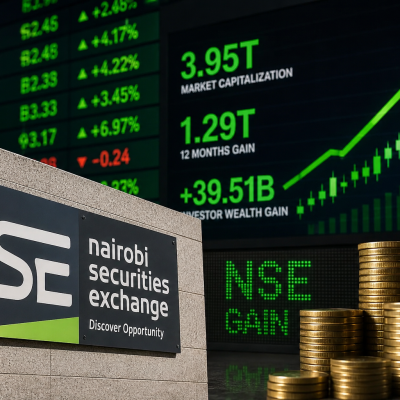
Kenya’s capital markets are back in business—and brokers and investment banks are among the biggest winners, pocketing billions as IPOs, bond deals and investment funds breathe new life into the Nairobi Securities Exchange.
Stockbrokers and investment banks nearly tripled their revenues in the first half of 2026, turning the NSE into one of the country’s hottest money-making corners for financial intermediaries.
The firms collectively generated Sh9.88 billion in revenue in the six months to June 2026, up sharply from Sh3.7 billion recorded during the same period last year.
Their combined net profit also more than tripled to Sh3.59 billion, compared with Sh1.15 billion a year earlier.
And behind the spectacular numbers are two major forces: the return of IPOs and the rapid growth of special investment funds.
The biggest money makers
Two firms dominated the industry, accounting for nearly half of the total revenue generated during the period.
| Brokerage/Investment Bank | H1 2026 Revenue |
|---|---|
| Faida Investment Bank | Sh2.69 billion |
| Standard Investment Bank (SIB) | Sh2.07 billion |
| NCBA Investment Bank | Sh830 million |
| KCB Investment Bank | Sh668.4 million |
| Dry Associates Investment Bank | Sh663.3 million |
| Dyer & Blair Investment Bank | Sh649.4 million |
Figures are based on the Business Daily analysis of industry financials.
Faida’s Kenya Pipeline jackpot
Faida Investment Bank emerged as the biggest revenue earner after landing a lucrative role in the Sh106 billion Kenya Pipeline Company IPO.
The investment bank acted as the lead transaction adviser and negotiated a success fee equivalent to one percent of the IPO’s gross proceeds.
The deal dramatically transformed its books.
Faida’s advisory fee revenue jumped from just Sh15.2 million in the first half of 2025 to Sh1.96 billion in the six months to June 2026.
Its investment management fees also rose to Sh454.5 million, from Sh85.2 million a year earlier.
The result was a dramatic jump in profitability, with Faida’s net profit soaring to Sh800.5 million, compared with only Sh49 million in the same period last year.
In other words, one major capital-markets deal radically changed the firm’s financial fortunes.
SIB rides the Mansa X wave
Standard Investment Bank was another major beneficiary of Kenya’s revived appetite for investment products.
SIB generated Sh2.07 billion in revenue, while its net profit reached approximately Sh1.1 billion.
A major contributor was its investment-management business.
The firm collected Sh1.8 billion in management fees from its Mansa X funds, whose assets under management expanded dramatically to Sh189.5 billion in June 2026, up from Sh76.7 billion a year earlier.
SIB also benefited from its role in major transactions, including the Family Bank listing and the Sh13 billion I&M Bank corporate bond issue.
The numbers demonstrate how the Kenyan brokerage business is increasingly moving beyond simply earning commissions from buying and selling shares.
NSE trading is back
The revival has also been visible on the Nairobi Securities Exchange itself.
Stockbrokers reported a 73 percent increase in commissions to Sh2.76 billion in the first half of 2026.
The NSE itself recorded a three-fold increase in half-year net profit, rising to Sh736.9 million from Sh272.3 million.
The exchange attributed the stronger performance to increased participation by institutional and retail investors.
A major boost also came from a huge block trade involving 6.01 billion Safaricom shares valued at Sh204.3 billion, which significantly increased market liquidity and turnover.
The NSE described the period as a major turning point for the country’s capital markets.
“The period under review marked a significant turning point for the NSE, with a notable resurgence in listing and capital-raising activity.”
The exchange also noted that the successful listings of Kenya Pipeline Company and Family Bank ended an IPO drought of more than a decade.
The return of the old stockbroking giants
Interestingly, the new capital-markets boom is also giving standalone brokerage firms a fresh lease of life.
Faida, Standard Investment Bank and Dyer & Blair are among the traditional players now appearing prominently among the industry’s biggest earners.
This comes after years in which bank-backed investment firms had gained significant ground because of their deeper pockets and broader financial networks.
Dyer & Blair, for example, recorded Sh649.4 million in revenue during the period.
The firm also generated Sh515 million in transaction income, helped by its role as placing agent for the Sh40 billion Safaricom corporate bond.
But making billions comes at a cost
The impressive revenue numbers do not mean all the money went straight into shareholders’ pockets.
Operating costs across the industry increased sharply from Sh2.1 billion in June 2025 to Sh5.2 billion this year.
Faida recorded the highest expenses at Sh1.89 billion, followed by Dyer & Blair at Sh500 million and SIB at Sh476.7 million.
Despite the rising costs, the overall profitability of the industry still improved dramatically.
A new era for Kenya’s capital markets?
The figures point to a dramatic reversal of fortunes for Kenya’s brokerage industry.
Just three years ago, the sector was struggling through a prolonged bear market that had hammered trading commissions and deal-making activity.
In the first half of 2023, the entire industry generated only Sh2 billion in revenue and Sh365 million in net profit.
Fast-forward to 2026, and revenue has climbed to nearly Sh10 billion, while profits have jumped to Sh3.59 billion.
The difference has been the return of market activity.
A bull run that began in 2024 increased buying and selling of shares, while the return of IPOs and growth of specialised investment funds created new revenue streams.