Several companies listed on the Nairobi Securities Exchange (NSE) are increasing or maintaining dividend payouts even as their profits come under pressure, signalling a growing focus on shareholder returns in a challenging business environment.
Regulatory filings show that at least nine listed companies have either increased or maintained their dividends despite recording declines in earnings. Another nine companies increased their dividend payouts at a faster pace than their profit growth.
Among the companies raising dividends despite lower profits are Absa Bank Kenya, Standard Chartered Bank Kenya, BOC Kenya, Centum Investment Company and Kenya Power. TPS Eastern Africa, CIC Insurance Group, Kenya Re and Liberty Kenya Holdings have, meanwhile, maintained their payouts despite weaker earnings.
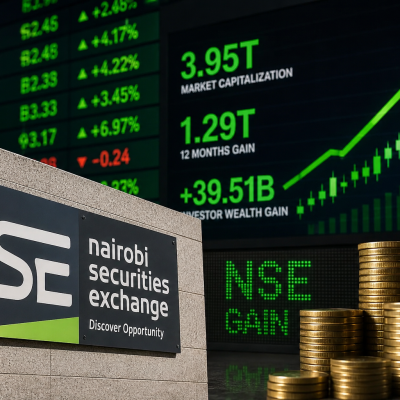
The trend comes as investors enjoy significant gains on the NSE, with the Nairobi bourse having delivered a 26 percent return since the beginning of the year.
Why are companies paying more?
Analysts say the rising payouts reflect growing pressure on listed companies to demonstrate value to shareholders, particularly after a strong rally in share prices.
Erick Musau, executive director for research and sustainable finance at Standard Investment Bank, said companies may feel compelled to ensure that investors receive returns that match the appreciation in their share prices.
“The general trend on the NSE over the past two years is that share prices have gone up, with investors moving away from fixed-income instruments and more into equities,” Musau said.
He added that mature companies with fewer opportunities for aggressive expansion may also have more cash available to distribute to shareholders.
Dividend payments can also help companies maintain shareholder confidence and reduce pressure on management.
“Dividend management also helps companies avoid shareholder discontent,” Musau said, noting that rewarding investors can make management less vulnerable to shareholder attempts to replace them.
BOC, Absa and StanChart raise payouts
BOC Kenya is among the latest companies to increase its dividend despite weaker earnings.
The company raised its interim dividend by 60 percent to Sh4 per share, even as net profit fell by 39.8 percent to Sh100.37 million for the six months ended June 2026.
Absa Bank Kenya increased its interim dividend by 150 percent to Sh0.50 per share, from Sh0.20, despite a 9.8 percent decline in net profit to Sh10.53 billion.
Standard Chartered Bank Kenya also increased its interim dividend by 6.3 percent to Sh8.50 per share, despite a 16.8 percent decline in net earnings.
Absa’s interim CEO Yusuf Omari said the bank had sufficient capital to support growth in its loan book and deposits while remaining within regulatory capital requirements.
The bank’s decision, he explained, followed stress tests that showed it could distribute more earnings without compromising its ability to fund future business.
Multinationals have another reason to pay
Multinational-owned companies may have an additional incentive to maintain strong dividend payouts.
Companies such as Standard Chartered, BAT Kenya and East African Breweries PLC (EABL) have large multinational shareholders who rely on dividends as an important avenue for receiving returns from their Kenyan investments.
According to Musau, dividends can be particularly important for multinational shareholders seeking to repatriate returns from their local operations.
Some companies are rewarding shareholders after restructuring
Centum Investment Company offers another example of a company increasing dividends despite weaker earnings.
Centum increased its dividend 2.5 times to Sh0.78 per share, comprising an ordinary dividend of Sh0.42 and a special dividend of Sh0.36.
This came despite an 8.5 percent decline in net profit to Sh743.9 million for the year ended March 2026.
The increase follows a major balance-sheet restructuring that left the investment company debt-free.
Musau said the improved financial position has given Centum greater room to return cash to shareholders after years of focusing on its balance sheet.
Banks lead the dividend growth
The banking sector has also emerged as a major driver of the trend.
NCBA increased its full-year 2025 dividend by 29.1 percent to Sh7.10 per share, compared with seven percent growth in profit to Sh23.4 billion.
Its 2026 interim dividend subsequently increased by 50 percent to Sh3.75 per share, while first-half profit rose 12.2 percent.
KCB increased its dividend per share by 133 percent to Sh7 in 2025, partly reflecting proceeds from the sale of National Bank of Kenya. This came alongside an 11 percent increase in profit to Sh68.4 billion.
The bank’s interim dividend also increased by 50 percent to Sh3 per share, while first-half profit grew by 14.2 percent.
DTB and Co-operative Bank similarly increased dividends faster than profits in 2025, with payouts rising by 28.6 percent and 66.7 percent, respectively.
Not every company is increasing dividends
While some firms are increasing payouts, others are choosing to maintain dividends to protect shareholder returns during periods of weaker earnings.
TPS Eastern Africa, which operates the Serena hotel business, maintained its Sh0.35 per share dividend despite a 40.2 percent decline in profit to Sh787.2 million.
CIC Insurance Group also maintained its Sh0.13 per share dividend despite an 82 percent collapse in earnings to Sh513.8 million.
Kenya Re retained its Sh0.15 per share dividend after profit fell 11.6 percent to Sh3.92 billion, while Liberty Kenya Holdings maintained its Sh0.50 per share payout despite a 65.3 percent decline in profit to Sh487 million.
What does it mean for investors?
The divergence between profits and dividends highlights an important shift in how some NSE-listed companies are managing shareholder expectations.
Rather than linking dividends strictly to the latest profit figure, companies are increasingly considering their cash position, capital requirements, debt levels, shareholder expectations and confidence in future earnings.
For investors, higher dividends can provide an attractive income stream, particularly when combined with gains in share prices.
However, a rising dividend does not necessarily mean that a company is performing better financially. Investors still need to assess whether the payout is supported by sustainable cash flows and a strong balance sheet.
The current trend therefore reflects a broader balancing act: companies are trying to preserve investor confidence and reward shareholders while navigating weaker margins, subdued demand and rising operating pressures.