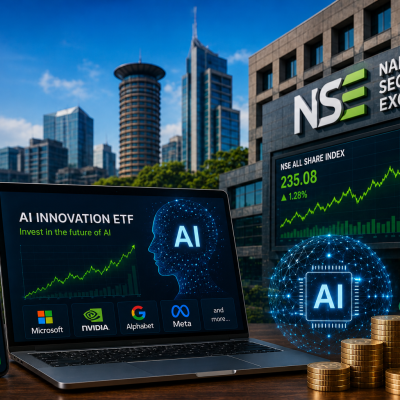
Many Kenyans are unaware that they can legally invest in some of the world’s largest publicly traded companies, including Nvidia, Tesla, Meta, Amazon and Netflix, with experts noting that the capital required to get started can be as little as one US dollar.
Technological advancements and the rise of fractional share investing have significantly lowered the barriers to accessing international markets, allowing ordinary investors to own portions of shares in global companies without purchasing a full stock.
Minimum investment
The minimum amount required depends on the broker or investment platform being used, but some platforms allow investments from as little as $1 through fractional shares.
How Kenyans can invest in global stocks and ETFs
To access offshore stocks and exchange-traded funds (ETFs), investors need to use a licensed broker. Some of the platforms accessible to Kenyans include:
- Hisa
- Interactive Brokers
- Ndovu
- Scope Markets
Satrix MSCI World Feeder ETF, recently introduced through the Nairobi Securities Exchange (NSE), offers another route into global markets. The fund tracks the MSCI World Index, providing exposure to more than 1,500 companies across 23 developed markets.
What to consider when choosing a broker
Here are some prospective investors to evaluate brokers based on:
- Low transaction costs to minimise trading expenses.
- Access to physical shares instead of Contracts for Difference (CFDs).
- Availability of stocks and ETFs, as some brokers offer a wider selection than others.
- Regulatory oversight, ensuring the platform is licensed and supervised by relevant authorities.
ETFs versus individual stocks
For long-term investors, diversified ETFs are better than trying to pick individual winning stocks.
Research shows that many active investors fail to outperform the broader market over time, making ETFs a simpler and potentially more effective investment option for beginners.
Examples of global ETFs highlighted
Among the investment products, Kenyans can consider:
- Vanguard S&P 500 ETF (VOO) – Tracks the performance of 500 of the largest publicly listed companies in the United States.
- Invesco NASDAQ 100 ETF (QQQM) – Invests in 100 of the largest non-financial companies listed on the Nasdaq exchange.
- VanEck Semiconductor ETF (SMH) – Provides exposure to leading semiconductor companies and firms benefiting from the growing artificial intelligence industry.
Tax considerations
Kenyans investing in international markets should also be aware of tax obligations, including:
- Capital gains tax, which generally depends on the investor’s country of residence and applicable local tax laws.
- Dividend withholding tax, with dividends from US-domiciled ETFs typically subject to a 30 per cent withholding tax for foreign investors.
Why consider investing globally?
There are several reasons why investors may want to diversify beyond the local market:
- Protection against currency depreciation: The Kenyan shilling has weakened significantly against the US dollar over the past decade, potentially eroding purchasing power.
- Access to stronger-performing markets: Historically, major US stock indices have delivered higher long-term returns than the Nairobi Securities Exchange.
- Exposure to developed economies: International markets provide access to larger, more liquid companies operating across diverse industries and regions.
As financial literacy continues to grow in Kenya, experts say greater awareness of offshore investing could give local investors more opportunities to diversify their portfolios and participate in the growth of some of the world’s biggest companies.