Period reviewed 28 September to 4 October 2026
Kenya-focused intelligence on developments affecting household wealth, investment choices and Market Cap Trainers content priorities.
Confirmed developments
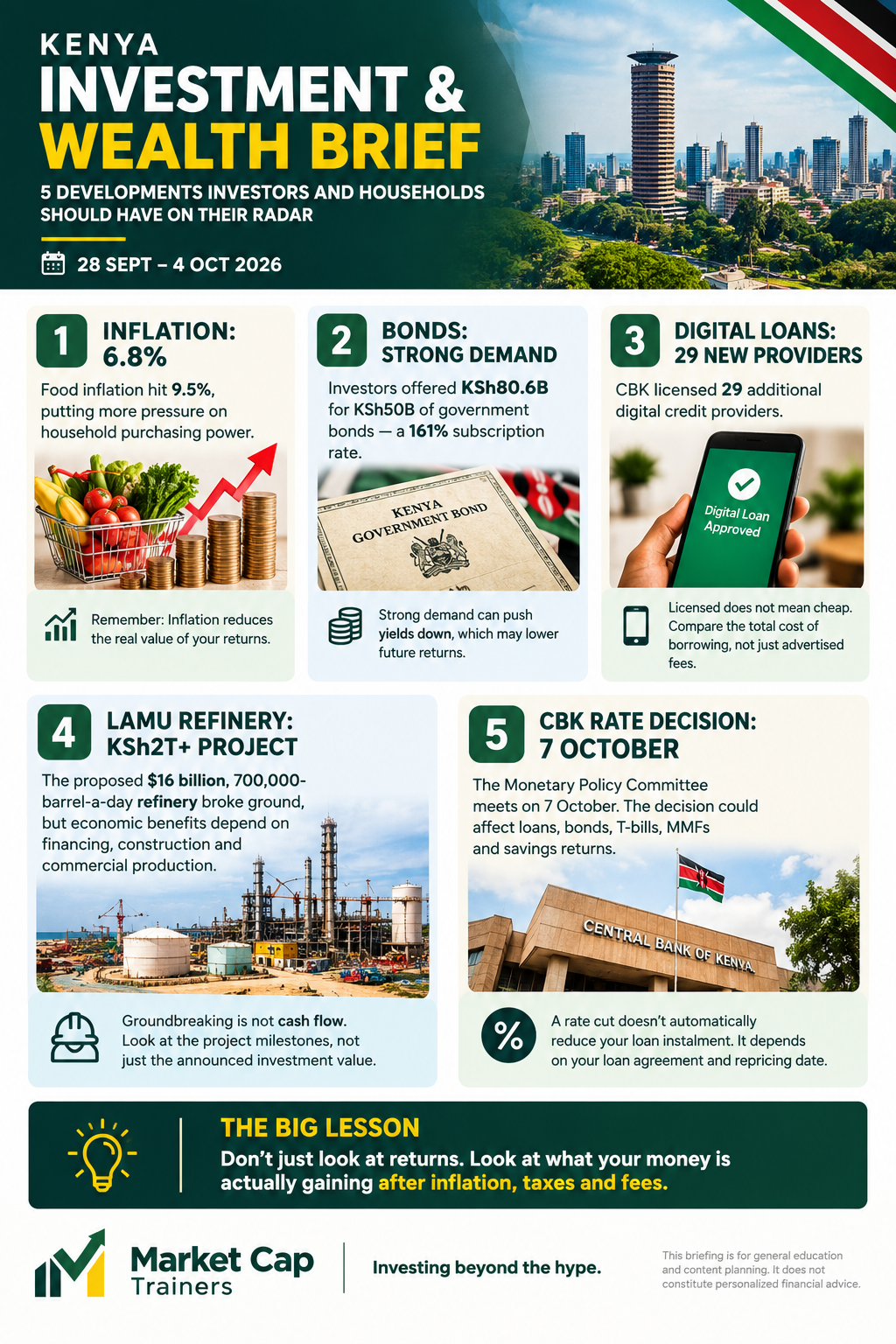
1. Inflation climbed to 6.8 percent, further squeezing real returns
Summary: Kenya’s annual inflation rose from 6.6 percent in August to 6.8 percent in September. Food inflation reached 9.5 percent, transport 15.6 percent, and core inflation increased from 3.4 percent to 4.0 percent. Inflation remains within CBK’s 2.5–7.5 percent target range, but it has exceeded the 5 percent midpoint for six consecutive months.
Why it matters: Households face sustained pressure on essential expenses, while the purchasing-power gain from savings, money-market funds and Treasury bills is narrowing after tax and fees.
MCT angle: “Your investment earned 9 percent—but how much wealth did it actually create?” Contrast nominal returns with after-tax, after-inflation returns.
Practical lesson: Use an approximate calculation: real return equals return after tax and fees minus inflation.
Sources: KNBS September CPI report
2. Investors heavily oversubscribed government securities
Summary: Investors offered KSh80.6 billion for KSh50 billion of reopened 15- and 20-year bonds—a 161 percent subscription rate. Treasury bills separately attracted KSh47.7 billion against KSh28 billion offered, while accepted rates edged lower.
Why it matters: Strong demand can push government borrowing rates downward. That benefits Treasury but may gradually reduce returns available to T-bill, bond and MMF investors. Long bonds also expose investors to substantial price volatility if sold before maturity.
MCT angle: “Why falling bond yields can create gains for existing bondholders but lower returns for new buyers.”
Practical lesson: Compare coupon, purchase price and yield to maturity separately. A high coupon does not guarantee an equally high return, particularly when a reopened bond trades above face value.
Sources: CBK Treasury bills and bonds
3. CBK licensed 29 more digital credit providers
Summary: On 30 September, CBK announced the licensing of 29 additional digital-credit providers. The action expands the regulated segment of a market whose rapid growth and borrower exposure were highlighted in the latest banking-sector data.
Why it matters: More licensed providers may improve access and competition, but licensing does not mean every loan is inexpensive or appropriate. Fees, repayment periods, rollover behaviour and debt-collection practices still matter.
MCT angle: “Licensed does not mean cheap: how to compare digital loans without being fooled by a small fee.”
Practical lesson: Convert every charge into the total shillings repayable and compare loans over the same borrowing period. Verify the provider directly through CBK rather than relying on an app-store listing.
Sources: CBK press releases
4. A 16 billion dollar Lamu refinery project broke ground, but benefits remain distant
Summary: Dangote Industries held a groundbreaking ceremony on 30 September for a proposed 16 billion dollar, 700,000-barrel-a-day refinery at Lamu Port. If completed, it would materially alter East Africa’s petroleum-supply structure.
Why it matters: Kenya imports petroleum products, so domestic refining could eventually influence supply security, foreign-exchange demand, employment and infrastructure. A ceremony, however, does not produce immediate pump-price savings.
MCT angle: “Groundbreaking is not cash flow: the five stages between a mega-project announcement and economic impact.”
Practical lesson: Assess large projects by milestones—financing, land and permits, construction progress, commissioning and commercial production—not by announced investment value alone.
Sources: Reuters project report
Confirmed event with an unresolved outcome
5. CBK’s next interest-rate decision arrives on 7 October
Summary: The Monetary Policy Committee is scheduled to meet on 7 October. No rate decision has yet been made. September’s higher headline and core inflation may complicate the balance between supporting credit growth and containing prices.
Why it matters: The Central Bank Rate influences bank-loan pricing, Treasury yields, MMF returns, bond valuations and eventually economic activity.
MCT angle: “What changes in your financial life when CBK moves its policy rate?”
Practical lesson: Do not assume a policy-rate cut immediately reduces an existing loan instalment. Transmission depends on the loan agreement, reference rate, repricing date and lender.
Sources: CBK Monetary Policy Committee
Risks and claims to treat cautiously
- Lamu project execution: A court dispute concerning land rights remained unresolved around the groundbreaking. Legal, financing and construction risks mean the refinery should not yet be treated as operating capacity.
- Interest-rate forecasts: Commentary ahead of the MPC meeting is speculation until CBK publishes its official decision.
- Immediate fuel savings: No verified evidence shows that the refinery announcement will reduce Kenyan pump prices in the near term.
Priority content shortlist
| # | Suggested headline | Recommended format |
| 1 | A 9% Return Is Not 9% Wealth Growth: Kenya’s Inflation Reality | Carousel with a worked example |
| 2 | Licensed Does Not Mean Cheap: How to Compare Digital Loans | Short video and WhatsApp checklist |
| 3 | Why Investors Bid KSh80 Billion for Government Bonds | Educational blog |
Editorial note: This briefing is for general education and content planning. It does not constitute personalized financial advice.